Stamped Concrete vs. Pavers in Frederick: Which Is Best for Your Patio?
Two homeowners can look at the same Frederick County backyard and land on completely different answers about what to install underfoot. One wants a seamless, custom-colored surface that ties together outdoor kitchens, fire pits, and seat walls in a single continuous pour. The other wants a modular system where a single damaged unit lifts out and a replacement drops in without cutting a saw across the whole patio. When comparing stamped concrete vs pavers in Frederick, both are legitimate answers. The right choice for your patio depends on your budget, how you use the space, your subgrade soil, and how you feel about ongoing maintenance. This guide walks through the honest trade-offs on cost, durability, repair, and long-term appearance in Frederick County's Mid-Atlantic climate, so you can make the call that fits your property and stick with it.
The Two Choices, Side by Side
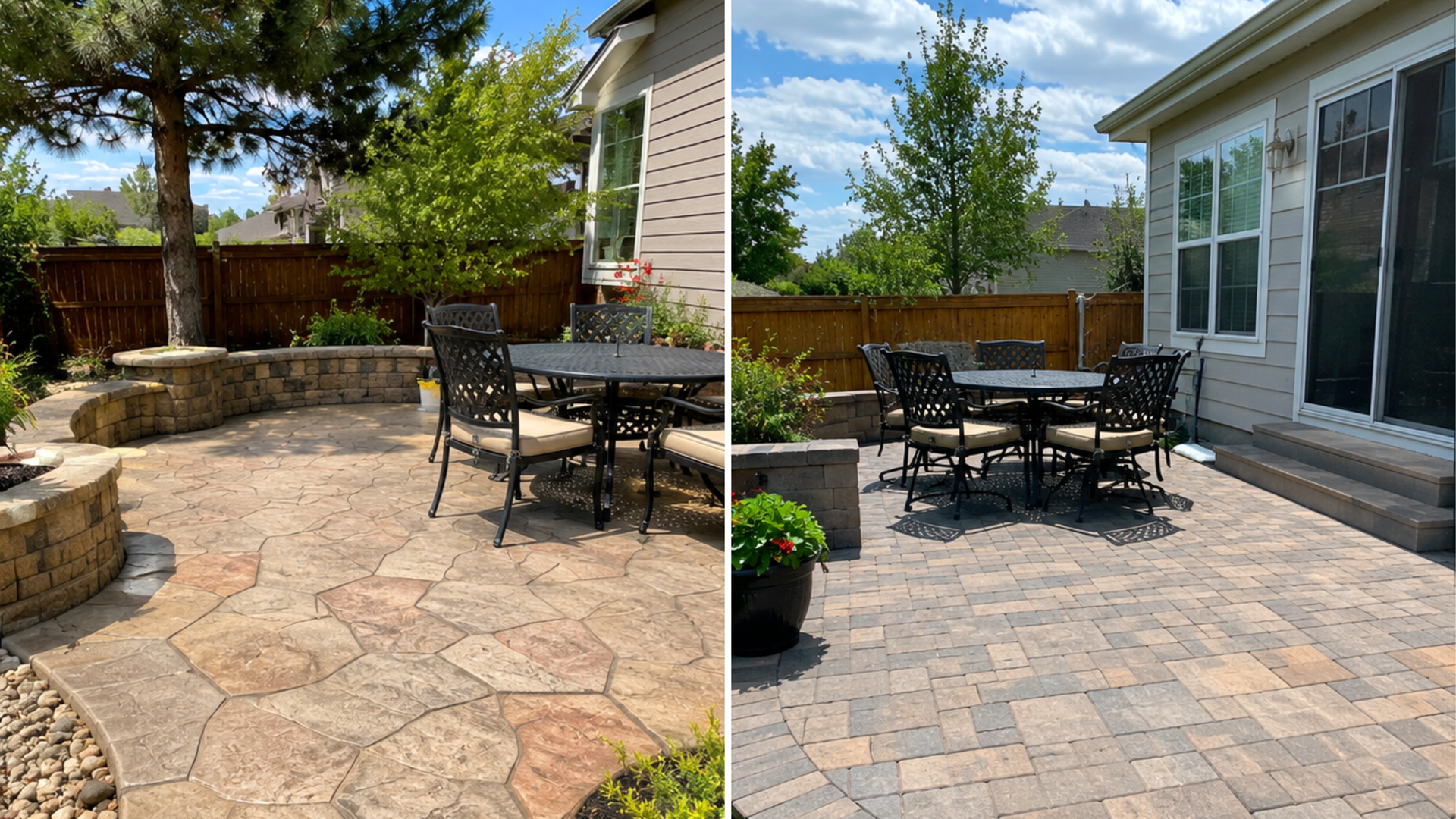
Before the cost and maintenance details matter, it helps to know exactly what you are comparing. These two categories cover the vast majority of residential patio installations across Frederick County.
What Stamped Concrete Actually Is
Stamped concrete is a single monolithic pour, finished before the concrete fully sets by pressing rubber texturing mats into the surface to imprint patterns like slate, flagstone, brick, or wood plank. Color is added two ways: an integral color mixed into the concrete itself, and an accent release color applied at the stamping stage. Once cured, the surface is sealed with a UV-resistant topcoat. The finished product is one continuous slab with control joints cut every 8 to 10 feet to manage cracking.
What Interlocking Pavers Actually Are
Pavers are individual manufactured units, typically concrete or clay, sometimes natural stone, laid in a pattern over a compacted crushed stone base with polymeric sand swept into the joints. Each paver acts independently, so the finished patio flexes slightly with ground movement instead of behaving as one rigid slab. The Interlocking Concrete Pavement Institute (ICPI) publishes installation standards for the base depth, joint width, and edge restraints that separate a paver patio built to last from one that heaves within two winters.
Here is a quick side-by-side reference before we get into the trade-offs.
| Factor | Stamped Concrete | Interlocking Pavers |
|---|---|---|
| Installation time | 1 to 3 days plus cure | 3 to 7 days |
| Walkable timing | After 7 day cure | Same day |
| Base depth | 4 to 6 inches | 6 to 10 inches |
| Reinforcement | Rebar or wire mesh | None (base does the work) |
| Flex under movement | Rigid; cracks at joints | Flexes with ground |
| Weed and ant joints | None | Ongoing |
| Repair method | Patch, overlay, or replace | Lift individual paver |
| Sealer maintenance | Every 2 to 3 years | Optional every 2 to 3 years |
| Design flexibility | Any pattern, any color | Manufacturer catalog |
Initial Installation Cost in Frederick County
Cost is where most homeowners start, and the honest answer is that stamped concrete is usually cheaper up front. Not by a huge margin, and not in every case, but generally yes. The ranges below reflect what Frederick County property owners can expect for a fully installed 400 square foot patio in 2026, including subgrade prep, base, materials, and labor.
| Material Tier | Per sq ft | Installed on 400 sq ft patio | Notes |
|---|---|---|---|
| Standard stamped concrete | $12 to $18 | $4,800 to $7,200 | Single color, basic pattern |
| Premium stamped concrete | $18 to $25 | $7,200 to $10,000 | Multi-color, borders, complex pattern |
| Standard concrete pavers | $15 to $22 | $6,000 to $8,800 | Manufactured interlocking |
| Premium concrete pavers | $22 to $30 | $8,800 to $12,000 | Large format, permeable |
| Natural stone pavers | $25 to $40 | $10,000 to $16,000 | Bluestone, travertine, granite |
Two variables push a project toward the top of these ranges: challenging site access that forces wheelbarrow hauling instead of truck delivery, and difficult subgrade that needs extra excavation or geogrid stabilization. Frederick County's clay-heavy soils sometimes require that extra prep, particularly in older neighborhoods with fill soil around the foundation.
Evaluating Durability with a Local Frederick Concrete Contractor
Determining the best stamped concrete vs pavers Frederick option for your home depends heavily on proper subgrade compaction and drainage. Working with an experienced Frederick concrete contractor ensures that whether you select pavers or decorative stamped concrete, your base is prepared with a compacted crushed aggregate layer that resists settling and shifting during winter freezes. Skip this step and either material fails, sometimes within the first year.
How Each Surface Handles Frederick's Freeze-Thaw Cycles
Frederick County sees about 40 to 55 freeze-thaw cycles each year based on NOAA regional data. Water expands roughly 9 percent as it freezes, and that expansion is what breaks apart poorly designed outdoor surfaces. Stamped concrete resists freeze-thaw damage well when the mix is properly air-entrained, control joints are cut on schedule, and the sealer is refreshed on time. Pavers handle freeze-thaw a different way. Because each paver is independent, expansion between units is absorbed at the joints. That is a real advantage on ground that shifts, though it comes at the cost of joint sand that washes out over time and needs replacing.
The Role of Base Preparation and Subgrade Compaction
Base prep is the part homeowners never see and never think about until something goes wrong. It is also the single biggest predictor of long-term performance for either material. Stamped concrete needs 4 to 6 inches of compacted CR-6 or #57 stone under a reinforced slab. Pavers need 6 to 10 inches of compacted base for a patio, deeper for driveway loads. Both require the subgrade below that base to be graded and compacted, not just backfilled and left. A quick way to identify a shortcut contractor: they never mention what happens under the surface.
Clay Subgrade Challenges in Frederick County
Much of Frederick County sits on the Chester and Glenelg soil series, both of which have significant clay content. Clay swells when wet and shrinks when dry, and that movement is what pulls outdoor surfaces apart over decades. On stamped concrete, clay movement shows up as cracks along or near control joints, sometimes with a slight vertical offset between slab sections. On pavers, clay movement shows up as individual pavers rising or sinking relative to their neighbors, creating tripping hazards and uneven walking surfaces. The fix for both materials is the same: a properly compacted base that isolates the finished surface from clay movement below. When that base is right, either material can last 25 years or more in Frederick County.
Long-Term Maintenance: What You'll Actually Do Each Year
The maintenance conversation is where a lot of homeowners change their mind mid-project. Both surfaces need care. The type of care is very different.
Stamped Concrete Maintenance
Stamped concrete asks for a small handful of scheduled tasks. Reseal the surface every 2 to 3 years with a UV-resistant, breathable sealer. Recaulk control joints every 3 to 5 years to keep water from working underneath the slab. Clean grease and food stains promptly, especially on lighter integral colors. That is roughly it. There is no ongoing joint sand replacement, no weed pulling, no polymeric sand top-off after heavy rain.
Paver Maintenance
Paver maintenance involves more small, ongoing tasks. Polymeric sand needs replacing every 2 to 3 years as it washes out, cracks, or degrades under UV exposure. Weeds and ants find any joint that has lost sand, so spring and summer usually involve some spot treatment. Individual pavers may settle or heave and need lifting and resetting. Sealer is optional but recommended, especially for lighter concrete pavers that show staining. On the flip side, when a paver stains or breaks, you can replace one unit without touching the rest of the patio.
| Annual Task | Stamped Concrete | Pavers |
|---|---|---|
| Reseal surface | Every 2-3 yrs | Optional |
| Re-sand or replace joint sand | Not needed | Every 2-3 yrs |
| Weed and ant treatment at joints | Rare | Ongoing |
| Recaulk control joints | Every 3-5 yrs | Not needed |
| Reset settled or heaved units | Not applicable | As needed |
| Deep clean and pressure wash | Yearly | Yearly |
| Check for cracks | Yearly | Not needed |
Repair and Replacement Realities
At some point over a 20 or 30 year lifespan, both surfaces need repair. The nature of that repair is one of the biggest differences between the two.
Repairing Damaged Stamped Concrete
A cracked or stained stamped concrete slab can be patched, but color and pattern matching is imperfect. A skilled installer can get close, and after resealing the whole surface the repair usually blends acceptably. For more serious damage, the fix is often an overlay: a thin new stamped layer poured over the existing slab. Both approaches work, but neither is invisible. Setting the right expectation upfront saves a lot of frustration later.
Repairing or Replacing Individual Pavers
Paver repair is one of the material's biggest structural advantages. A damaged unit lifts out with a paver puller, a fresh unit drops in, and the patio looks continuous again. Settling and heaving repairs work the same way in reverse: lift the affected pavers, regrade or add base material underneath, reset the pavers, sweep in fresh polymeric sand. For homeowners in older Frederick County neighborhoods with settled patios, this repair-friendly quality is often the deciding factor.
Aesthetic Options and Design Flexibility
Both materials give you a huge range of design choices. They arrive at that flexibility from opposite directions.
Stamped Concrete Design Range
Stamped concrete can imitate almost any patterned surface: cobblestone, slate, flagstone, herringbone brick, wood plank, ashlar slate, seamless textures. Color options are essentially unlimited because integral color mixes can be blended to spec. You can also add borders, medallions, saw-cut inlays, and custom logos into the pour. The look is highly customizable, but the pattern is committed the day the concrete is stamped, so the design decision has to be locked in before pour day.
Paver Design Range
Pavers give you the exact look of the real material because they often are the real material. Bluestone pavers are actual bluestone. Clay brick pavers are actual clay. The design flexibility comes from mixing shapes, sizes, and colors within a single installation, and from being able to change part of a pattern later by swapping units. The trade-off is that you are choosing from what manufacturers make. Wildly custom colors or bespoke shapes usually mean natural stone at natural stone prices.
Which Wins in Common Frederick Backyard Scenarios
Here is where the material comparison gets useful. Different Frederick County properties have different constraints, and one material tends to fit each scenario better than the other.
Small Backyard, Tight Budget
Stamped concrete usually wins. Lower installed cost per square foot, no ongoing joint maintenance to chase, and a high-end look on a modest budget. On a 250 to 400 square foot patio, the cost difference alone often pays for a full sealer schedule for the first decade.
Large Entertaining Patio with Outdoor Kitchen or Fire Pit
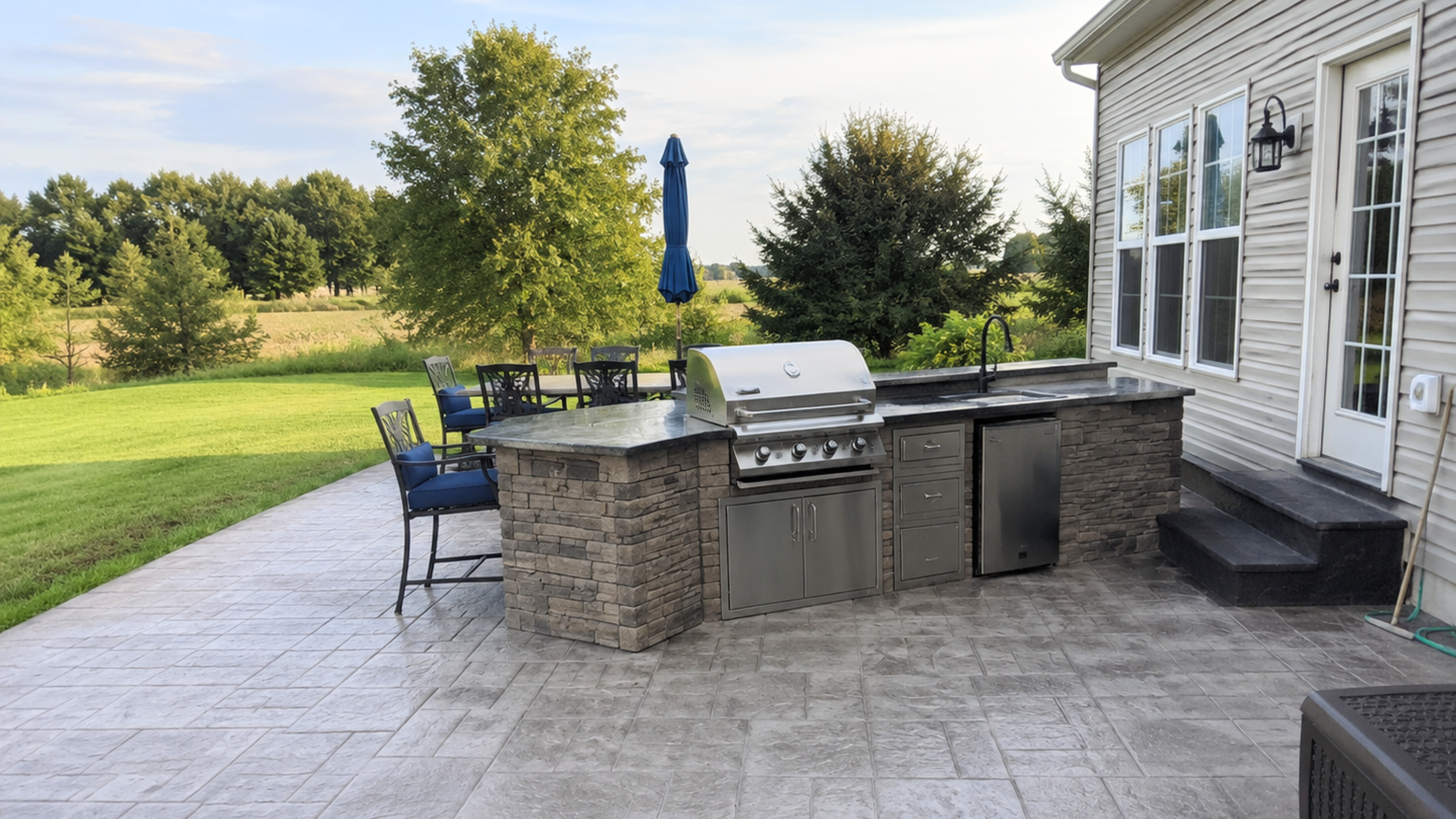
Stamped concrete wins here too, because the same continuous slab that supports the patio also supports the built-in kitchen, seat walls, or fire feature. If you are already planning an outdoor kitchen on a concrete patio in Frederick or a concrete fire pit patio in Frederick, the integrated pour is more structurally sound and looks more intentional than dropping those features onto a paver base.
Sloped or Drainage-Challenged Lots
Pavers often win on tricky drainage or sloped sites, especially with a permeable paver system that lets water infiltrate directly through the joints. Permeable pavers can also help with stormwater management requirements that some Frederick County subdivisions enforce. On stubborn slopes, the flex tolerance of pavers over compacted base handles minor movement more gracefully than a rigid slab.
Historic Homes and HOA Neighborhoods
The right answer depends entirely on the HOA. Some Frederick County covenant communities restrict decorative concrete colors and patterns. Others restrict paver colors or require a specific product line. Historic districts sometimes require materials that match the original property. Always pull the HOA design guidelines and any historic district rules before you finalize your material choice, because the wrong pick can force a costly redo.
The Honest Bottom Line: When to Choose Each
- Choose stamped concrete when you want a lower installed cost, a seamless custom look, minimal joint maintenance, and structural continuity for built-in features like an outdoor kitchen, seat walls, or a fire pit. Also choose it when you love a specific pattern or color combination that pavers cannot deliver.
- Choose pavers when you want the flexibility to replace individual units after damage, when your site has drainage or slope challenges that benefit from permeable installation, when your HOA or historic district requires a specific paver product, or when you specifically want the appearance of a real material like bluestone or clay brick.
Neither is universally better. The Frederick County homeowner who values low ongoing effort and a unified look leans stamped. The one who values easy repair, drainage flexibility, and a modular system leans pavers. Both, installed correctly, will still be there in 25 years.
Working With a Frederick County Concrete and Hardscape Team
Whichever material you land on, base preparation, drainage, and installation quality decide whether the patio holds up. Interview your contractor on those specifics, not just on their portfolio photos. Ask what base depth they run for your soil type. Ask how they handle joint layout on stamped concrete or edge restraints on pavers. Ask to see recent Frederick County projects that have been through at least two winters. A good contractor answers directly and backs it up with references or a site visit.
Prostamp Concrete has spent more than a decade installing concrete patios, stamped and decorative finishes, and outdoor living surfaces across Frederick County, Walkersville, Thurmont, Hagerstown, and Waynesboro. Our expertise sits on the concrete and stamped side of the comparison in this article. If you have already decided stamped concrete or a standard concrete patio is the right fit for your property, we can walk your site, review your design ideas, and put together a written estimate covering every phase of the project. If you land on pavers as your answer, we are happy to talk through the base and layout considerations even if the finished installation ends up in the hands of a paver specialist.
Frequently Asked Questions
Which is cheaper in Frederick, stamped concrete or pavers?
Stamped concrete is usually less expensive per installed square foot. Standard stamped runs roughly $12 to $18 per square foot in Frederick County, while standard concrete pavers run $15 to $22 per square foot. The gap widens with premium tiers, since natural stone pavers can reach $40 per square foot installed. On a typical 400 square foot patio, the up-front savings on stamped concrete is often $1,000 to $4,000.
Do stamped concrete or pavers crack more in freeze-thaw?
Pavers do not crack in the way concrete does because each unit acts independently. Movement is absorbed at the joints rather than tearing through a monolithic slab. Stamped concrete resists cracking well when the mix is air-entrained, control joints are correctly placed every 8 to 10 feet, and the sealer is refreshed on schedule. Both materials perform well through Frederick County winters when installed correctly. Both fail predictably when base prep is skipped.
Can you install pavers over an existing concrete patio in Frederick?
Sometimes, yes, but the existing slab has to be in good condition, properly graded for drainage, and structurally sound. An overlay pavement system uses thin pavers set on a bond coat or fine bedding layer over the existing concrete. The finished surface height changes, which can affect door thresholds, drainage patterns, and adjoining hardscape. Always have a contractor evaluate whether the underlying slab is a good candidate before assuming an overlay is the shortcut it looks like.
Which lasts longer, stamped concrete or pavers?
Both can last 25 to 30 years or more when installed correctly. Stamped concrete relies on the mix, reinforcement, and joint layout holding up. Pavers rely on the base staying stable and joint sand being refreshed. The failure modes differ: stamped concrete usually fails at cracks, and pavers usually fail at settling or joint erosion. Poor installation shortens both lifespans dramatically.
Do HOAs in Frederick County restrict stamped concrete or paver colors?
Some do, and it varies widely by community. Certain HOAs in Urbana, Ballenger Creek, and other Frederick County subdivisions publish approved material and color lists. Others restrict any hardscape changes visible from the street. Always request the current design guidelines and any architectural review requirements before finalizing your material choice.
Which is easier to repair after a Frederick winter?
Pavers, by a wide margin. A heaved or damaged paver lifts out with a paver puller and gets replaced individually. Stamped concrete repairs involve patching or overlaying sections, which is harder to color match perfectly. If ease of repair is high on your priority list, that alone can tip the decision toward pavers.
Ready to Compare Stamped Concrete and Pavers for Your Frederick Patio?
The choice between stamped concrete and pavers is genuinely not one-size-fits-all. It comes down to your budget, your site, your maintenance appetite, and how you plan to use the space over the next 20 years. What matters more than the material choice itself is that the base prep, drainage, and installation quality are handled correctly for whichever surface you pick.
Prostamp Concrete has spent more than a decade pouring, stamping, and finishing concrete patios across Frederick, Walkersville, Thurmont, Hagerstown, and Waynesboro. If you are leaning toward stamped concrete or a decorative concrete patio and want a written estimate that spells out every phase of the project, call (240) 803-7830 or request an estimate online. We are also happy to walk through the trade-offs on your specific property before you commit to either material.